
Lee County Court Records After Arrest
A Lee County jail arrest creates a booking record first. That record may show the arresting agency, arrest charge, bond status, and basic jail custody facts if the information is released. It is not the final court record. The formal case begins when a prosecutor files a complaint, information, indictment, or related charging paper. In Lee County, that prosecutor role is not split into a separate district attorney office. The Lee County Attorney states that the county has no dedicated district attorney, so the County Attorney represents the State in misdemeanor cases and also handles felony prosecution and grand jury presentation in district court.
That local structure matters. Court records after a jail arrest may involve the County Attorney, the District Clerk, a Justice of the Peace, or a municipal court depending on the charge level and issuing agency. Custody and booking details belong with the sheriff and jail. Filed charges and court settings belong with the clerk and court. Booking photos are a separate records issue, so current custody details belong on the Lee County jail inmate records page and photo requests belong on the Lee County jail mugshots page.
The Lee County District Clerk page is the main county source for district court docket links, local rules, criminal e-filing notes, court payment information, fee schedules, and expunction-address material. Its docket notice says settings are subject to change until docket call, so a docket entry should be treated as a current court schedule, not a full case history.
Find Lee County Court Records After Arrest
Start with the court channel that matches the case. Felony cases and higher-level criminal matters usually route through the District Clerk and the 21st or 335th Judicial District Court docket links. Misdemeanor prosecution routes through the County Attorney. Traffic citations and some lower-court matters route to the Justice of the Peace named on the citation or courtesy letter. The sheriff's public-information page also directs criminal-history requests to Texas DPS, because the Lee County Sheriff's Office says it cannot provide complete criminal history or driving records.
- Confirm the booking or arrest through the Lee County Jail, sheriff records process, or a known event number.
- Decide whether the matter is likely felony, misdemeanor, JP traffic, municipal, state, federal, or juvenile.
- Check the District Clerk docket links for criminal docket settings when the case belongs in district court.
- Contact the clerk or prosecutor when a docket PDF does not show the case number, disposition, or next setting.
- For criminal history rather than a local case file, use the Texas DPS route named by the sheriff public-information page.
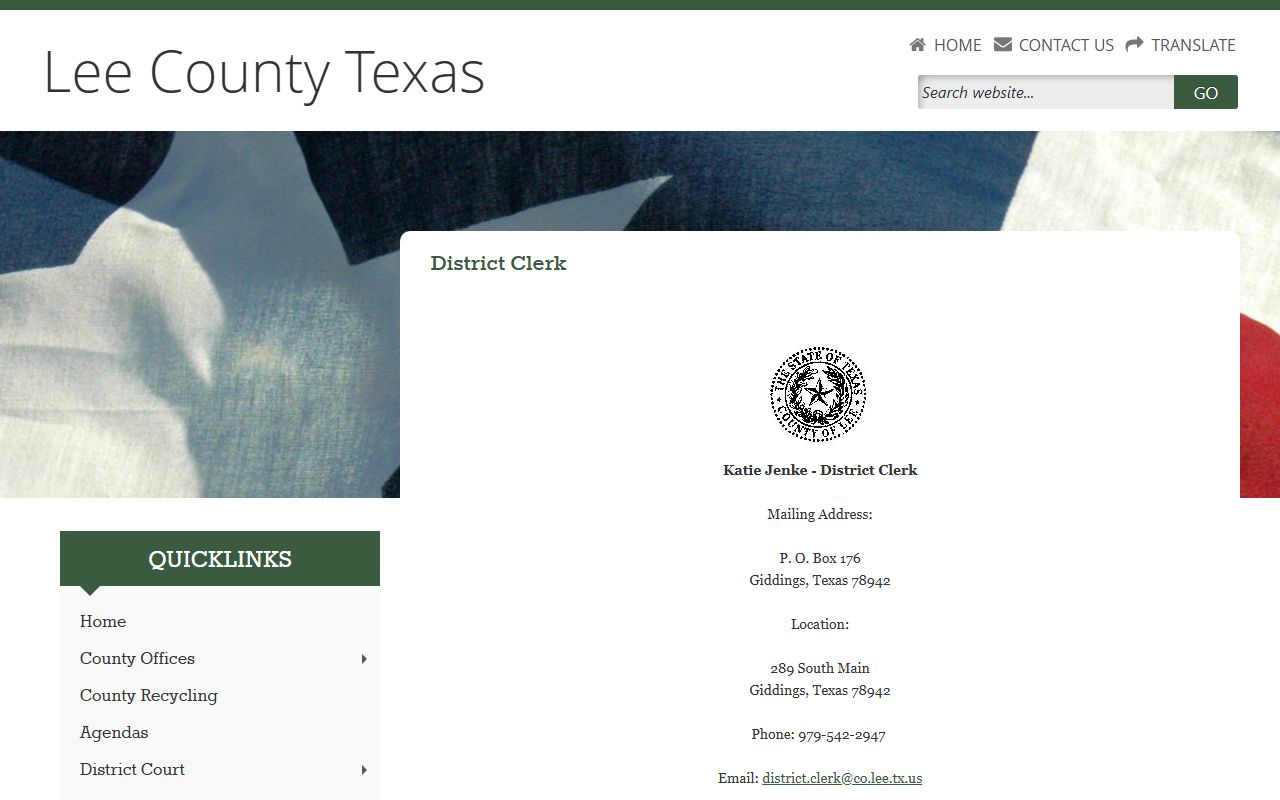
The District Clerk page does not provide an interactive criminal case-search form in the official county materials reviewed. It provides dated docket PDF links and supporting court documents. That means Lee County court records after arrest may require a direct call or email to the clerk when a public docket is not enough. District Clerk Katie Jenke's office lists P.O. Box 176, 289 South Main, Giddings, Texas 78942, phone 979-542-2947, and district.clerk@co.lee.tx.us.
| Lee County source | What it helps verify | Limit |
|---|---|---|
| District Clerk dockets | Criminal docket dates, district-court settings, local rules, fee schedule, expunction address material. | Dockets are PDF links, not a full public case-search portal. |
| County Attorney | Misdemeanor and felony prosecution routing, victim assistance, open-records link, VINE notification link. | The office is not the jail roster and does not replace clerk file access. |
| Justice of the Peace courts | Traffic citations, lower-court matters, bench warrant questions tied to that court. | Use the specific JP named on the citation or notice. |
Lee County Charging Records
After a Lee County arrest, the first charge seen by family members may be the arrest or booking charge. That can be based on an officer report, a warrant, or jail intake paperwork. The filed charge is different. The prosecutor may file the same charge, change the level, add a charge, decline a charge, or present a felony matter to a grand jury. Because Lee County has no dedicated district attorney, the County Attorney's felony role is a key local fact in the court-records-after-arrest pathway.
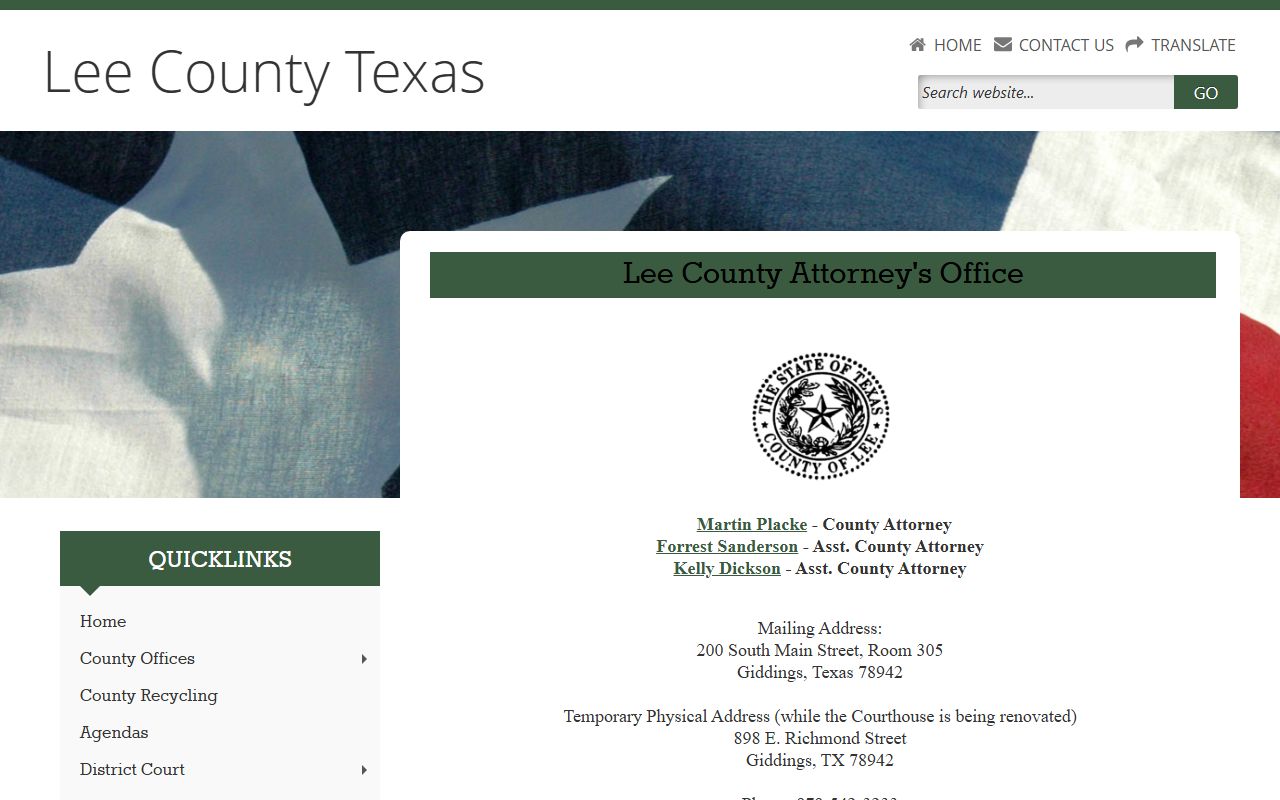
The Lee County Attorney page identifies County Attorney Martin Placke, assistant county attorneys, victim-assistance staff, misdemeanor and felony division contacts, an open-records link, and a VINELink route. The office lists a mailing address at 200 South Main Street, Room 305, Giddings, Texas 78942, and a temporary physical address at 898 E. Richmond Street during courthouse renovation.
| Document | Who usually drives it | How it fits after arrest |
|---|---|---|
| Complaint | Officer or prosecutor | A sworn allegation or charging paper that can start a criminal proceeding. |
| Information | Prosecutor | A prosecutor-filed charge often used for misdemeanors or certain non-indicted cases. |
| Indictment | Grand jury | A grand-jury charging document, commonly tied to felony prosecution. |
The official County Attorney capture shows why the prosecution page is part of a Lee County court-record search after arrest: the County Attorney source explains the no-dedicated-district-attorney structure and lists prosecution-side contacts.
Use that page for prosecution routing, not for current jail custody. A person can be booked at the Lee County Jail before the filed charge appears in a court docket.
Lee County Charge Status
Charge status is the reason a court record after arrest can look different from the booking entry. The jail may list the charge used at intake, while the court file shows the formal charge later filed by the prosecutor. A pending charge means the court has not reached a final outcome. An amended or reduced charge means the charge changed in the court or prosecution record. A dismissed charge means prosecution ended on that charge without a conviction.
| Status | Plain meaning | What to check in Lee County |
|---|---|---|
| Pending | The charge remains unresolved. | Review the current docket and ask the District Clerk about the next setting. |
| Amended | The filed charge changed. | Compare the booking charge with the later court charge. |
| Reduced | The offense level or count was lowered. | Check the final filed charge, not just the arrest charge. |
| Dismissed | The charge ended without conviction. | Ask whether any related charge, hold, or warrant remains. |
The District Clerk docket screenshot is tied to the official Lee County District Clerk page, which links criminal dockets and notes that settings are subject to change until docket call.
A docket can confirm a setting or court event, but the clerk remains the better source for file access questions, case numbers, and whether a record is sealed or restricted.
Bond After Lee County Arrest
Bond is part of the court path, but it is not proof that a case has ended. Texas Code of Criminal Procedure Art. 17.15 sets rules for fixing bail, including the nature of the offense, ability to make bail, public safety, and the rule that bail should not be used as an instrument of oppression. Lee County-specific online bond payment rules were not found on the sheriff pages reviewed. The supported local route is to call the Lee County Jail or Sheriff's Office at 979-542-2800 before trying to post bond.
| Bond type | How it works | Lee County caution |
|---|---|---|
| Cash bond | The full bond is paid in approved funds. | Call the jail for accepted methods before arrival. |
| Surety bond | A licensed bail bond company posts through a surety process. | Confirm the jail's acceptance process directly. |
| Personal or PR bond | The defendant is released on a promise to appear, often with conditions. | A court or magistrate sets it, not jail staff by request. |
| No-bond hold | Release is blocked by court order, warrant, detainer, or another agency. | One local bond may not clear all holds. |
Lee County Warrants and Arrest Records
No dedicated active-warrant search page was located on the Lee County Sheriff's Office site. The sheriff does host a Most Wanted module, but that is not a complete warrant database. It has an official disclaimer, an accept-to-continue screen, status filters, sorting controls, and name search. Absence from a most-wanted list does not mean there is no warrant.
For warrant questions, call the Lee County Sheriff's Office at 979-542-2800, or contact the court that issued the citation or order. The sheriff public-information page lists JP2 Judge Michael York at 979-542-3030, JP3 Judge Don Milburn at 979-773-2267, and JP4 Judge Danita Smith at 979-884-4001. District-court warrant questions can route to the District Clerk. Texas Code of Criminal Procedure Chapter 15 covers arrest under warrants, including authority to arrest under a warrant.
Note: A warrant can block release after a new Lee County arrest even when bond is posted on the new charge.
Lee County Charges vs Convictions
An arrest and a charge are accusations. A conviction is a court outcome based on a plea, verdict, or adjudication. This distinction matters for Lee County court records after a jail arrest because a public docket may show a filed charge long before the case is resolved. It also matters for employment, licensing, housing, and background-check contexts, where using raw arrest data as if it were a conviction can be misleading and legally risky.
| Record point | Charge | Conviction |
|---|---|---|
| Stage | Accusation filed after arrest or investigation. | Final finding, plea, or adjudication of guilt. |
| Proof level | Based on probable cause or prosecutor filing decision. | Requires a plea or proof beyond a reasonable doubt. |
| Can change | May be amended, reduced, declined, or dismissed. | May later be appealed, set aside, sealed, or expunged only when law allows. |
Lee County Expunction Records
Texas uses different paths for expunction and nondisclosure. Expunction under Code of Criminal Procedure Chapter 55 is the route that can remove eligible arrest records from official records. Nondisclosure under Government Code Chapter 411 limits public release of some criminal-history record information, but it is not the same as destroying the record. The District Clerk page also links expunction-address material, which is relevant when a Lee County arrest case becomes eligible for clearing.
| Record action | Public effect | Lee County record route |
|---|---|---|
| Nondisclosure or sealed record | Public access is limited, but some agencies may retain access. | Check court orders and clerk restrictions before relying on a public docket. |
| Expunction | Eligible records are removed or treated as not having occurred under the order. | Use the court and clerk process, not an informal removal request. |
| Dismissed charge | The charge ended without conviction, but the arrest record may still exist. | Ask whether Chapter 55 relief or another court order applies. |
Restricted Lee County Court Records
Some records tied to an arrest are not open the same way as a routine adult docket. Juvenile law-enforcement records are treated differently under Texas Family Code Section 58.007. Active investigations may be reviewed under the Texas Public Information Act before release. The sheriff open-records form says release may require a Texas Attorney General confidentiality determination, and it cites the ten-business-day issue tied to Government Code Chapter 552.
Lee County court records after a jail arrest are best read as a chain. Jail booking confirms custody. The County Attorney decides filed charges. The District Clerk maintains district-court docket material. A JP court may control citation and bench-warrant issues. Expunction or nondisclosure requires a court route. Each office can answer only for the records it creates or maintains.
Important: Public court and jail information may be incomplete or delayed. Verify charge status with the clerk or originating office.